
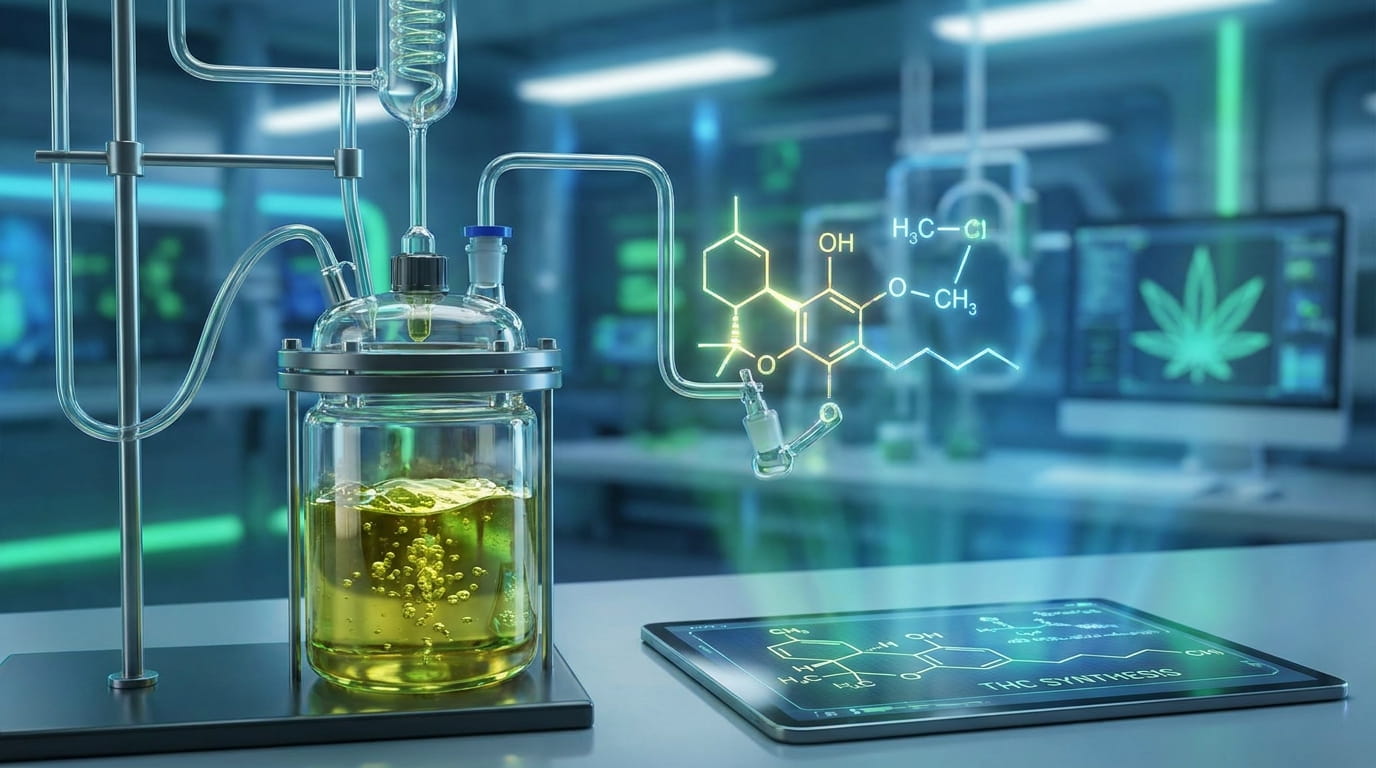
The phrase THC synthesis refers to three distinct chemical processes: how the cannabis plant naturally builds THC as it grows, how laboratories create synthetic or hemp-derived versions of the compound, and how the human liver transforms THC after consumption. Knowing how each stage works clarifies why cannabis behaves differently on drug screenings than almost any other tested substance.
Plant Biosynthesis
Living cannabis plants do not produce active Delta-9-THC directly. Instead, specialized resin glands on the plant’s flowers (trichomes) assemble cannabinoids through a sequence of enzyme-driven steps starting from simple organic precursors.
Step 1: The Precursor Compound (CBGA)
Inside the plant, enzymes combine olivetolic acid and geranyl pyrophosphate to form cannabigerolic acid (CBGA). Often called the “mother cannabinoid,” CBGA serves as the shared chemical starting block for nearly all major plant cannabinoids.
Step 2: Enzymatic Conversion to THCA
A dedicated enzyme called THCA synthase folds CBGA into tetrahydrocannabinolic acid (THCA). Fresh, raw cannabis flowers are rich in THCA rather than active THC. On its own, THCA is non-intoxicating because an attached carboxyl group prevents it from binding cleanly to cannabinoid receptors in the brain.
Step 3: Decarboxylation into Active THC
Exposure to heat, light, or prolonged aging removes that extra carboxyl group—a reaction known as decarboxylation. Smoking, vaporizing, or baking cannabis drives this final step, converting inactive THCA into psychoactive Delta-9-THC.
Key Term — Decarboxylation: The thermal release of carbon dioxide (CO2) from acidic cannabinoids like THCA, transforming them into their biologically active forms.
Lab Pathways
Outside the plant, chemists produce THC and THC-like molecules through two main routes that often get grouped together in news and drug-testing discussions.
Pharmaceutical and Semi-Synthetic THC
Prescription medications such as dronabinol (Marinol) contain laboratory-synthesized Delta-9-THC that is chemically identical to plant-derived THC. Similarly, commercially sold isomers like Delta-8-THC and Delta-10-THC are typically created through chemical isomerization of hemp-derived CBD rather than extracted directly from marijuana plants. Because these molecules share nearly identical core structures with natural Delta-9-THC, standard urine immunoassays generally cross-react with them and trigger a positive THC screen.
Synthetic Cannabinoid Receptor Agonists
Street blends historically sold under names like K2 or Spice are not structurally related to natural THC at all. Although they activate the same CB1 receptors in the brain—often far more aggressively—they are entirely separate chemical families. Routine workplace panels designed for natural THC metabolites do not detect these compounds unless a specialized synthetic cannabinoid panel is ordered separately.
Body Metabolism
Once active THC enters the bloodstream—whether from a plant or a lab-synthesized isomer—the body immediately starts breaking it down so it can be excreted. This internal metabolic synthesis is what standard drug screens actually measure.
First, liver enzymes (primarily the CYP450 family) oxidize Delta-9-THC into 11-hydroxy-THC (11-OH-THC), an active intermediate compound that crosses easily into the brain. Next, the liver oxidizes 11-OH-THC into 11-nor-9-carboxy-THC (THC-COOH), an inactive secondary metabolite.
Why THC Lingers: Unlike water-soluble drugs that flush rapidly through the kidneys, THC and THC-COOH are highly lipophilic (fat-loving). Excess molecules absorb into body fat and release gradually back into the bloodstream over days or weeks—the central reason clearance schedules in our Drug Detection Times and Super Detox Program guides depend heavily on body composition and usage frequency.
Testing Impact
Each drug-testing specimen captures a different point along THC’s chemical lifecycle, which is why detection windows vary dramatically across collection methods:
Urine Screening
Standard Urine Drug Testing does not look for active Delta-9-THC; it screens for fat-stored THC-COOH exiting through the kidneys at a standard 50 ng/mL immunoassay cutoff. Because THC-COOH releases slowly from adipose tissue, urine tests reflect usage days or weeks after impairment ends. This mechanism also explains how ingredients work inside a THC Detox Formula.
Oral Fluid (Saliva) Screening
Saliva Drug Testing primarily detects parent Delta-9-THC trapped in the oral cavity shortly after smoking, vaping, or ingesting cannabis. Because oral fluid tracks recent exposure rather than long-term fat storage, detection windows typically stay narrow—often 24 to 72 hours.
Hair Follicle Screening
As blood circulates through hair follicles, trace amounts of parent THC and THC-COOH become embedded inside the growing hair shaft. Hair Drug Testing typically evaluates the 1.5 inches closest to the scalp, creating an approximate 90-day retrospective record of repeated exposure.
Check Your Levels
Knowing which form of THC a screening targets makes at-home verification straightforward. You can check urinary THC-COOH status with a 13-Panel Urine Test Dip Card with FEN 1ng (CLIA Waived), evaluate recent oral exposure using a 12-Panel Oral Saliva Drug Test Screening Kit, or review long-term history with a Home Hair Follicle Test Kit. For same-day urine preparation, explore the Supreme Klean Ultra Mask Detox Drink.