
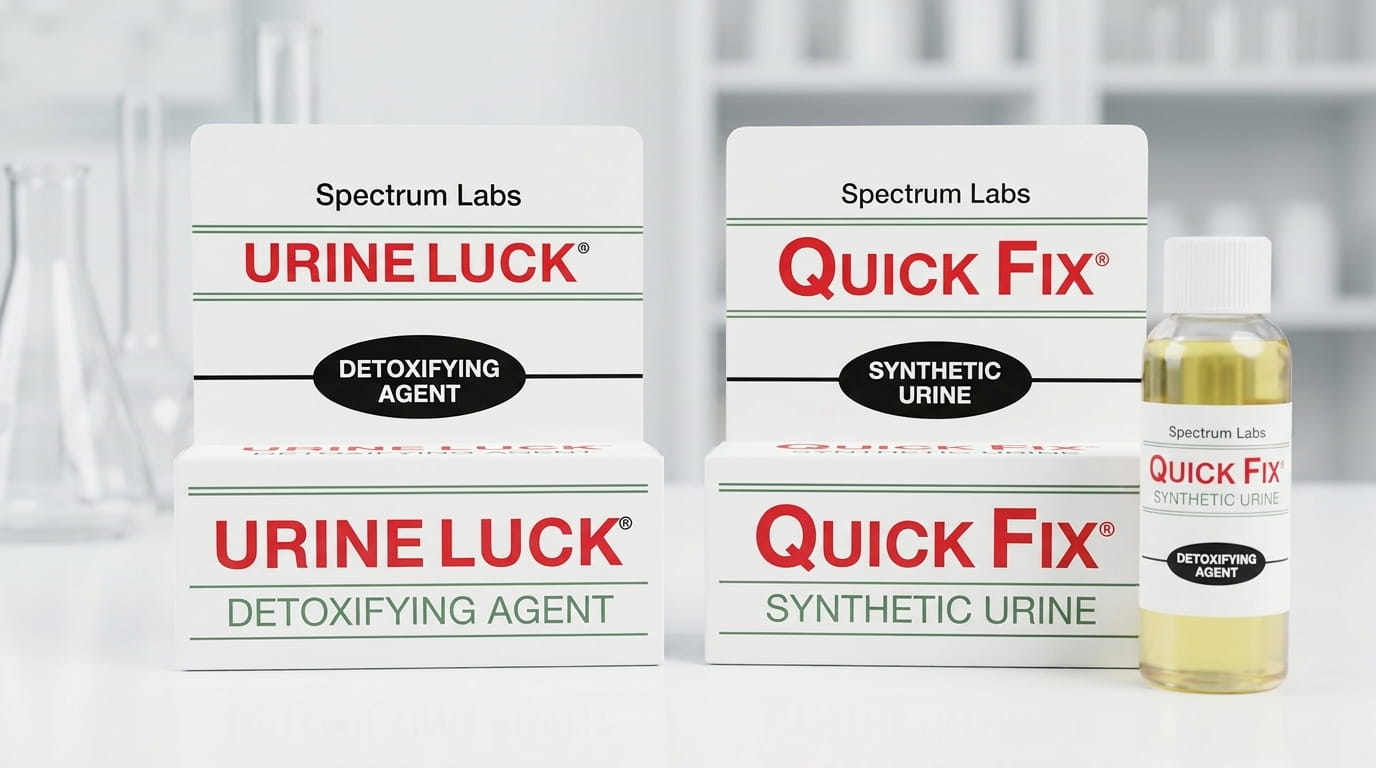
People searching for “urn luck quick fix” or “urine luck quick fix” usually expect a single product. In reality, the phrase combines two separate items from the same manufacturer—Spectrum Labs—that operate in completely opposite ways.
One Brand, Two Products
Spectrum Labs built its early reputation in the 1990s around Urine Luck, a liquid chemical additive poured into a natural urine sample. Years later, as laboratory testing began flagging chemical adulterants, the company introduced Quick Fix, a premixed synthetic urine formula, and sold it through its existing urineluck.com website. Because both products share one storefront and brand history, buyers still blend the two names together.
Urine Luck
Urine Luck is an in-sample chemical additive designed to alter a person’s own urine after collection. Early batches relied on pyridinium chlorochromate (PCC), an oxidizing agent that degraded THC metabolites on older screens. Newer versions use a reformulated two-vial solution intended to shift sample chemistry over a 45- to 90-minute reaction period. Because it chemically modifies urine, modern validity screens routinely target the oxidants and pH shifts it leaves behind.
Quick Fix
Quick Fix does not treat natural urine at all—it replaces it. It is a pre-blended laboratory liquid formulated to replicate standard human urine markers, including urea, uric acid, creatinine, balanced pH, and specific gravity. Instead of relying on a post-collection chemical reaction, synthetic urine focuses on matching natural baseline chemistry and maintaining a 90°F to 100°F temperature at handoff.
Never Mix Both
Urine Luck and Quick Fix are never meant to be used together. Adding chemical vials into premixed synthetic urine disrupts its calibrated pH and specific gravity, making an otherwise balanced liquid easy for a lab to flag.
Reaction Timing
Timing separates how these products behave on test day. Urine Luck requires 45 to 90 minutes inside the cup to react, which rules out instant clinic cups and rapid dip cards read on site. Synthetic urine requires heating before submission—typically via brief microwave warming and a heating pad—with no chemical wait time afterward.
Lab Detection
Certified laboratories run Specimen Validity Testing (SVT) on incoming samples to verify temperature, pH, creatinine, density, and oxidizing chemicals. Additives carry high detection risk because oxidants and abnormal acidity stand out immediately on automated analyzers. You can read how each checkpoint operates in our Urine Luck Drug Test breakdown or review historical versus current performance in Does Urine Luck Work?.
Common Misconceptions
Many positive anecdotes online praising “Urine Luck” actually describe experiences with Quick Fix ordered from the Urine Luck domain. Others date back decades before oxidant strips became standard at commercial collection labs. For a broader look at how standard workplace screens evaluate specimens, visit our Urine Drug Testing guide.
Pre-Balanced Synthetic Options
If you want to avoid reactive chemical additives and compare ready-to-use synthetic kits calibrated for standard pH, creatinine, urea, and specific gravity ranges, both the Ultra Pure 2 oz Synthetic Urine Kit and the larger Ultra Pure 4 oz Synthetic Urine Kit include an attached temperature strip and heating pad.